
Education is what remains after one has forgotten what one has learned in school.
The only thing that interferes with my learning is my education.
If you want to find the secrets of the universe, think in terms of energy, frequency and vibration.
Within you lies the pattern of the cosmos; discovering it is awakening to your true nature.
The mind becomes wise not by one discipline, but by discovering how all disciplines illuminate one another.
The Learning Spiral
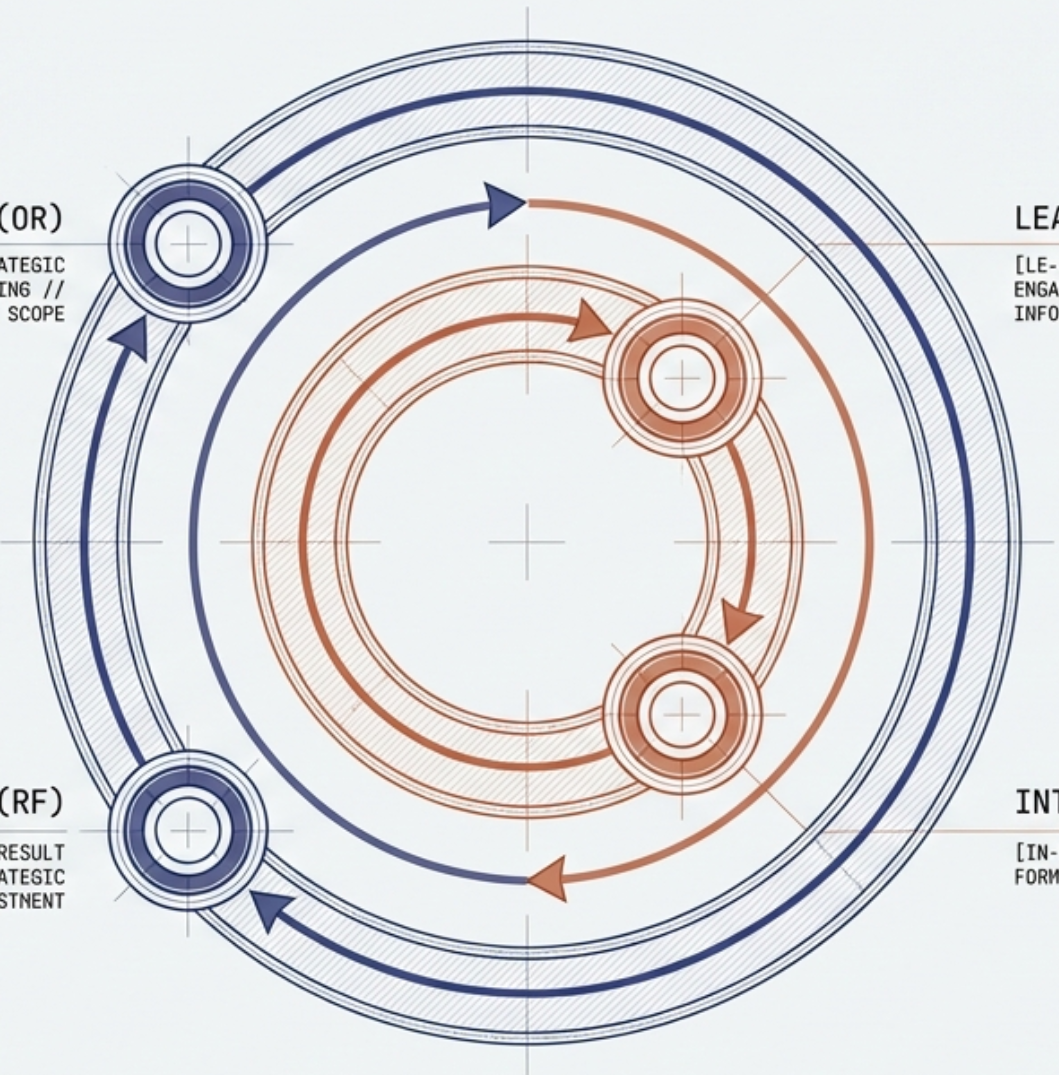
Learning is often presented as a straight path: lessons, assignments, tests, and completion. But real understanding rarely develops in a straight line. When people explore meaningful questions, learning tends to unfold through cycles of curiosity, investigation, and reflection. Each cycle deepens understanding and reveals new questions worth exploring.
The TODI Learning Spiral organizes learning around this natural process. Rather than moving through disconnected subjects, learners move through repeated cycles of exploration, understanding, and reflection. Over time, each cycle strengthens curiosity, insight, and independence.
The Learning Spiral Phases
The Learning Spiral is a simple four-phase process (OLIR). Each pass through this spiral deepens understanding and prepares the learner for the next exploration.
1. Orient
Choose a meaningful system, idea, or question to explore.
2. Learn
Investigate the topic through structured exploration.
3. Integrate
Demonstrate understanding through explanation and creation.
4. Reflect
Observe patterns in learning and identify new directions for exploration.
Mental Models in the Learning Spiral
The 🔎Learn ↔ 🧩Integrate loop is guided by mental models.
Mental models provide structured ways to explore complex ideas and systems. They help learners organize observations, identify relationships, and deepen understanding over time. Each mental model typically includes:
One example is Nova – Systems Thinking mental model, which helps learners explore real-world systems and recognize patterns across different domains.